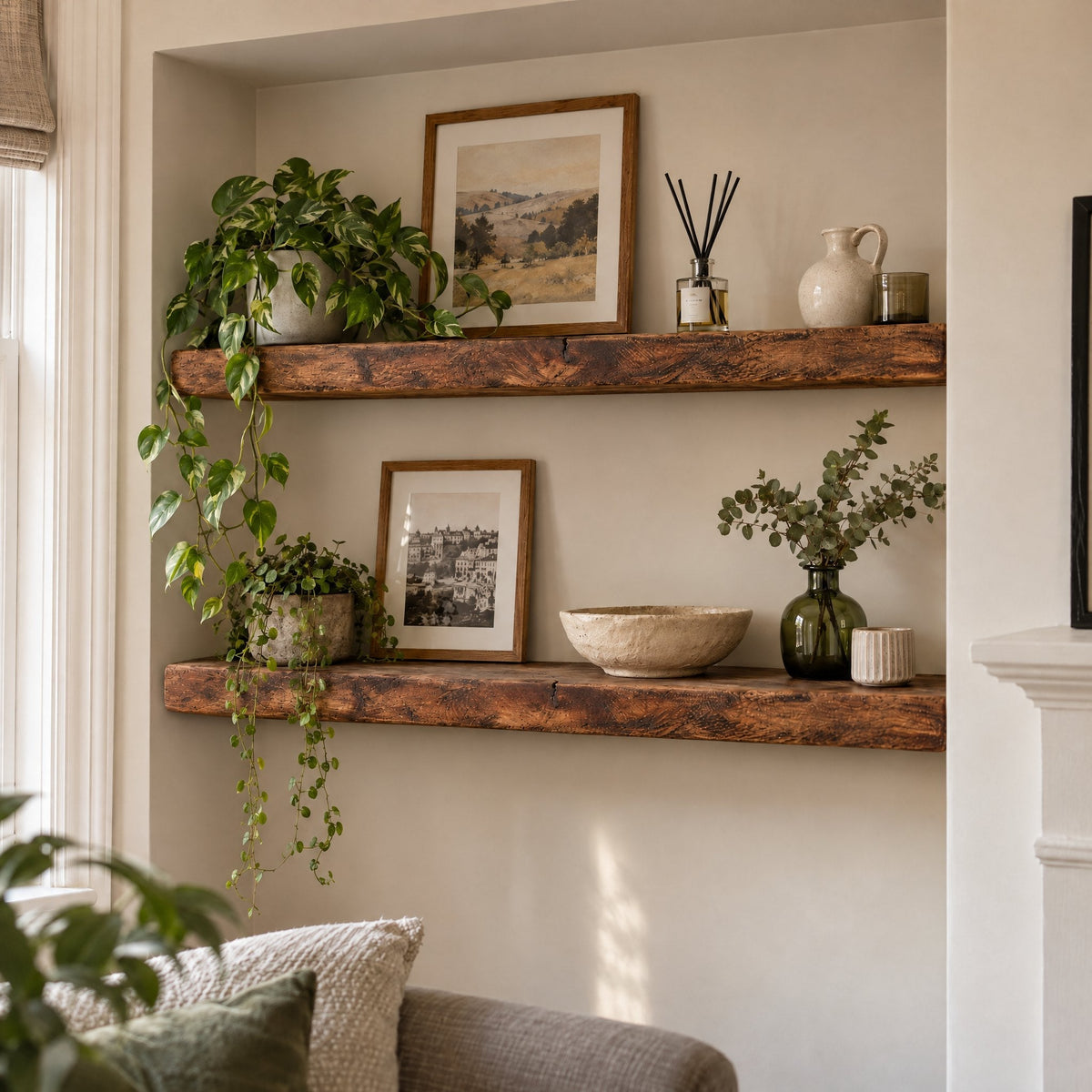
Alcoves either side of a chimney breast are the perfect place for floating shelves, but they're also where measuring goes wrong most often. Walls in older houses are rarely straight or parallel, so a few extra minutes with a tape measure saves a lot of frustration.
1. Decide how many shelves and where
Mark the height of each shelf lightly in pencil. A gap of 30 to 40cm between shelves suits most books and ornaments. Leave more space above the lowest shelf if there's furniture or a radiator below it.
2. Measure the width at every shelf height
Measure wall to wall at the height of each shelf. Alcoves often get wider or narrower as they go up, so don't assume one measurement works for every shelf.
3. Measure at the back and the front
Measure the width at the back wall and again at the front of the alcove, where the front edge of the shelf will be. Use the smaller of the two, or the shelf won't slide in.
4. Allow a little clearance
Take about 1cm off your smallest measurement so the shelf goes in without scraping the plaster. Then choose the nearest standard length below that figure. Our shelf size calculator does this for you and shows which shelves come in that size.
5. Choose your depth
Measure how far the chimney breast sticks out, too. A 20cm shelf suits books and sits well in most alcoves. For a slimmer look, or a shallow chimney breast, choose 15cm.
Between sizes?
Every Heritage shelf is cut to order, so if your alcove falls between our standard lengths we can cut one to fit exactly. Ask us for a quote with your measurements.
Ready to choose? Floating shelves are the most popular choice for alcoves: shop floating shelves.